Salaries in Switzerland: complete guide 2025

Switzerland is renowned for its high salaries, but also for its cost of living. How much can you realistically expect to earn? This comprehensive guide gives you all the tools you need to understand salaries in Switzerland and negotiate your remuneration effectively.
The median salary in Switzerland
In 2025, the gross median salary in Switzerland stands at approximately CHF 6,800 per month, or CHF 81,600 per year. This means that half of all workers earn more, and the other half earn less.
This figure varies considerably depending on the canton, the sector, the level of responsibility and experience. Zurich and Geneva offer the highest salaries, but also the highest cost of living.
Salaries by sector
The gaps between sectors are significant. Finance, pharma and IT offer the most attractive remuneration, whilst hospitality and retail sit at the lower end of the scale.
- Banking & Finance: CHF 100,000 - 180,000/year
- Pharma & Life Sciences: CHF 95,000 - 160,000/year
- IT & Digital: CHF 90,000 - 150,000/year
- Engineering: CHF 85,000 - 130,000/year
- Legal: CHF 80,000 - 200,000/year
- Marketing & Communications: CHF 70,000 - 120,000/year
- Human Resources: CHF 70,000 - 110,000/year
- Administration: CHF 60,000 - 90,000/year
- Hospitality & Catering: CHF 50,000 - 70,000/year
The impact of experience
Professional experience has a strong influence on salary. A junior professional (0–2 years) can expect 60–80% of the median salary in their sector, whilst a senior professional (10+ years) may reach 130–150%.
Management and executive positions offer significantly higher remuneration, often supplemented by bonuses and benefits in kind.
Regional differences
The canton in which you work has a significant impact on salary. Zurich, Zug and Geneva offer the highest remuneration (+10–20% compared to the national average), but the cost of living there is also higher.
Peripheral cantons (Ticino, Valais, Jura) offer salaries 10–15% lower, offset by a more affordable cost of living.
Always calculate your real purchasing power by taking into account rent, insurance and local taxes.
The 13th-month salary and bonuses
In Switzerland, the 13th-month salary is common but not mandatory. Approximately 80% of companies pay it, generally in December. Some incorporate it into the advertised monthly salary.
Bonuses vary by sector: almost standard in banking (20–100% of salary), less common in other industries (0–20%).
Benefits in kind and extras
Beyond the gross salary, many benefits can supplement your remuneration: company car, mobile phone, contribution to transport costs, meal subsidies, continuing professional development, and remote working.
Occupational pension provision (2nd pillar) deserves close attention: a generous employer contribution represents a significant long-term advantage.
Negotiating your salary effectively
Salary negotiation is expected and accepted in Switzerland. Come prepared with market data, quantified achievements and a realistic salary range.
The ideal time to negotiate is after receiving an offer, but before signing. Do not hesitate to ask for a few days to consider.
- Research market salaries (Glassdoor, Salarium OFS)
- Prepare your case: skills, experience, achievements
- Define your range: ideal / acceptable / minimum
- Negotiate the full package, not just the gross salary
- Obtain all agreements in writing
Taxes and social security contributions
From gross to net salary, expect a reduction of 12–15% for social security contributions (AVS, AI, APG, AC, LPP). Income tax is then added on top, ranging from 15–35% depending on the canton and your family situation.
Cross-border workers are subject to a specific tax regime: withholding tax in Switzerland for certain cantons, taxation in France with compensation for others.
Conclusion
Swiss salaries remain among the highest in the world, but must be viewed in the context of the local cost of living. Before negotiating, research the standards for your sector and region. Our CV analysis tool can help you highlight your skills to maximise your negotiating power.
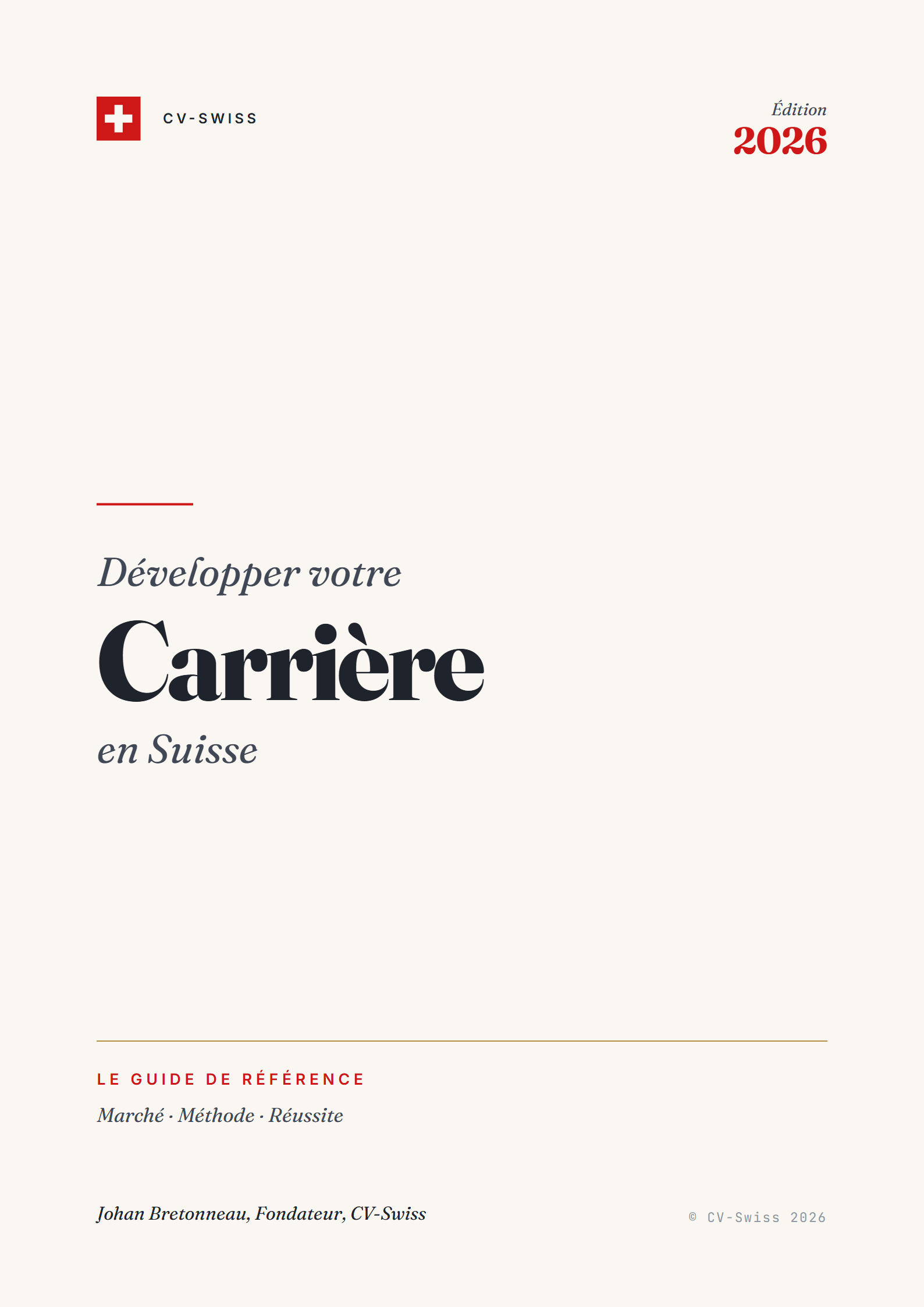
Vous voulez la méthode complète ?
Le Guide de Référence 2026 pour trouver, décrocher et négocier votre emploi en Suisse — 121 pages, chiffres officiels.
- 121 pages, 6 parties, 7 annexes
- Chiffres 2026 SECO, OFS, SEM
- 26 cantons, salaires par métier
Prêt à optimiser votre cv suisse ?
Analysez gratuitement votre cv suisse et découvrez comment améliorer vos chances de décrocher un entretien en Suisse.
Analyser mon CV gratuitement

Discussion (0)
Échange avec d'autres candidats. Les messages sont modérés automatiquement pour préserver un espace sain.
Connecte-toi pour participer à la discussion.
Se connecterAucun commentaire pour l'instant. Sois le premier à réagir !