Complete Guide to Swiss Work Permits 2025

Working in Switzerland requires a work permit in most cases. The Swiss system distinguishes between several types of permit depending on your nationality, the length of your stay and your professional situation. This guide helps you understand which one applies to you.
The B Permit: Residence Authorisation
The B permit is issued to foreign nationals residing in Switzerland for a fixed period, generally tied to an employment contract. For EU/EFTA citizens, it is granted for 5 years provided the employment contract is for at least 1 year.
For nationals from outside the EU/EFTA, obtaining this permit is more restrictive and subject to quotas. The employer must demonstrate that no suitable Swiss or European candidate is available for the position.
The B permit is renewable and may lead to a C permit after 5 or 10 years, depending on your nationality.
The C Permit: Permanent Settlement
The C permit grants permanent right of residence in Switzerland without restriction. It is generally awarded after 5 years (EU/EFTA) or 10 years (other nationalities) of continuous residence with a B permit.
C permit holders enjoy rights almost equivalent to those of Swiss nationals in terms of employment, and may freely change employer and canton.
The G Permit: Cross-Border Commuters
The G permit is intended for cross-border commuters — that is, individuals residing in a neighbouring country (France, Germany, Italy, Austria) and working in Switzerland.
The cross-border commuter must return to their place of residence at least once a week. This status offers tax advantages in certain cantons but entails daily commuting.
- Valid for 5 years for EU/EFTA citizens
- Must reside in the border zone (generally up to 20–30 km)
- Weekly return to place of residence is mandatory
- Specific tax arrangements under bilateral agreements
The L Permit: Short-Term Stay
The L permit is granted for stays of less than one year, typically for temporary assignments, internships or fixed-term contracts.
It is tied to a specific employer and is generally not renewable beyond 24 cumulative months over a 5-year period.
Procedures and Timescales
The process is generally initiated by the Swiss employer. Once the contract has been signed, the company submits the application to the cantonal authorities.
Timescales range from 2 weeks (EU/EFTA) to several months (non-EU). Please factor these timescales into your start-date planning.
Begin the process as soon as the contract is signed. Certain cantons such as Geneva or Zurich have longer processing times due to the volume of applications.
Conclusion
The Swiss permit system may appear complex, but it is well structured. Identify the permit that matches your situation and plan ahead for the associated timescales. An experienced Swiss employer will guide you through the process.
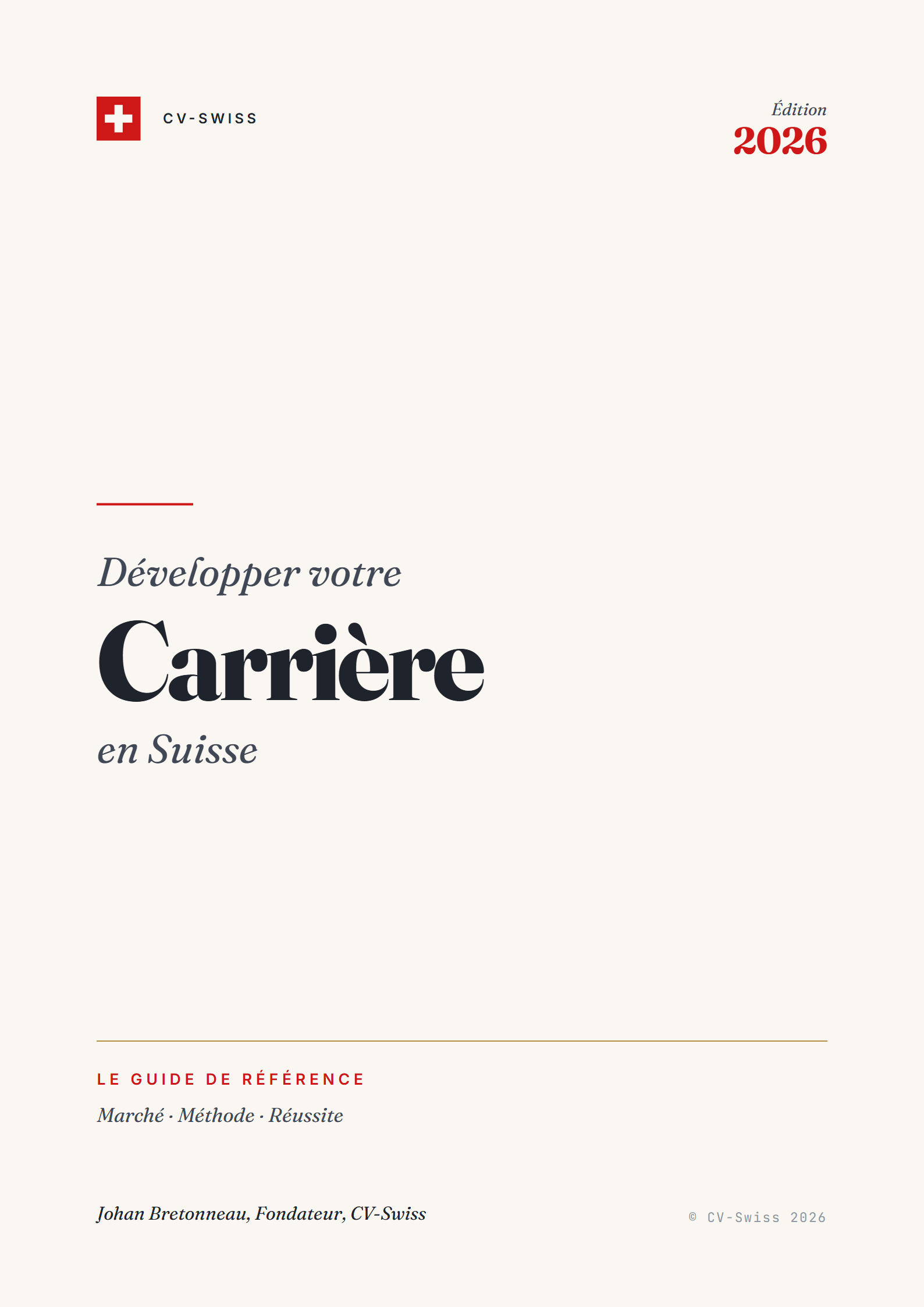
Vous voulez la méthode complète ?
Le Guide de Référence 2026 pour trouver, décrocher et négocier votre emploi en Suisse — 121 pages, chiffres officiels.
- 121 pages, 6 parties, 7 annexes
- Chiffres 2026 SECO, OFS, SEM
- 26 cantons, salaires par métier
Prêt à optimiser votre cv suisse ?
Analysez gratuitement votre cv suisse et découvrez comment améliorer vos chances de décrocher un entretien en Suisse.
Analyser mon CV gratuitement

Discussion (0)
Échange avec d'autres candidats. Les messages sont modérés automatiquement pour préserver un espace sain.
Connecte-toi pour participer à la discussion.
Se connecterAucun commentaire pour l'instant. Sois le premier à réagir !